Web Hosting Renewal Shock: How Irish Businesses Are Getting Caught Out (And How to Escape It)
Web hosting renewal shock is a deliberate industry practice that traps businesses with introductory prices, then doubles or triples the bill at renewal.

f you signed up for web hosting at an introductory price and just received a renewal notice that’s two, three, or four times higher, you’re not alone. Web hosting renewal shock is a deliberate industry practice, not a billing error. This article explains exactly how it works, what it actually costs Irish businesses, and what to look for when you’re choosing a host that won’t pull the rug from under you.
HostMaxa is a 100% Irish-owned web hosting and domain registration provider founded in 2023. We built this company specifically because renewal shock was costing our customers and Irish SMEs real money. What follows is how that model works, written by someone who built the alternative.
How the Loss-Leader Pricing Model Works, and Why It Always Ends the Same Way
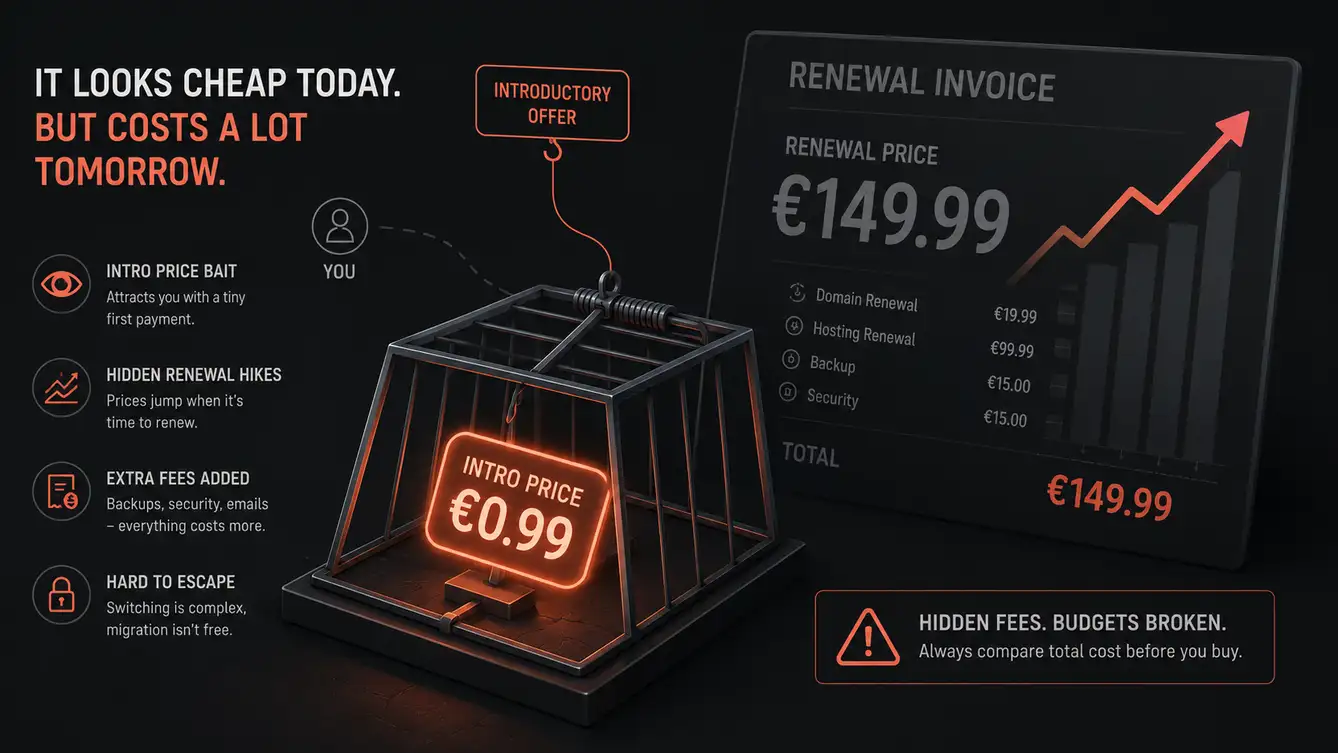
The loss-leader hosting model is built around a simple calculation: acquire customers cheaply, then profit heavily at renewal. A host that charges €0.99 for year one is not making money on that plan. They’re betting (correctly, historically) that most customers won’t switch when the bill triples.
Here’s the mechanics of it. International hosting companies spend heavily on advertising introductory offers. The €0.99 or €1.99 first-year price is funded by venture capital or cross-subsidized by existing customers paying full renewal rates. The host’s actual cost to serve a basic hosting account is typically in the €6-€15/month range once you factor in server hardware, power, support, and software licensing. So the €0.99 intro offer isn’t a deal, it’s a deferred debt you’ll pay back when you renew.
At renewal, the “regular price” kicks in. If you’ve ever switched electricity or broadband providers in Ireland, you’ll already be familiar with the model: you get a great introductory rate for the first year, then the standard price applies unless you switch again. Many web hosting companies work the same way. That often means going from €11 to €200+ per year overnight. Irish businesses that didn’t read the renewal terms (and most don’t) suddenly face a difficult choice: pay whatever is asked, or go through the pain of migrating to a new host (and start the cycle again).
What makes this worse is that switching costs are real. Moving a website involves DNS changes, potential downtime, re-configuring email, and often losing whatever setup you had. Hosts know this and price their renewals accordingly.
What “Cheap” Hosting Actually Costs Irish Businesses After The First Payment
Real renewal pricing from publicly-listed host rates tells the story. The numbers below are drawn from published standard prices at major providers operating in the Irish market as of mid-2026, not promotional rates.
A €0.99 introductory offer from a major host typically renews between €120 and €240 per year. A €2.99/month intro plan renews at €9.99-€14.99/month, a 230-400% increase. Some hosts add further price hikes in years three and four as they migrate customers to “updated plans.”
For an Irish small business owner running a bakery, a salon, or a trades company, this kind of jump represents real money. A €180/year increase is a tank of oil, two days of materials, or half a month’s phone bill. It’s also a clear breach of the trust you placed in the provider: the price you signed up for was never the price you were going to pay.
A concrete example. A restaurant in Galway signs up for hosting at €1.99/month, about €24 for year one. It seems like nothing. Year two, the renewal bill arrives: €168. The business owner rings the host to query it, waits 40 minutes on hold, and eventually gets offered €84 if they “upgrade” to a new plan that requires them to rebuild their email configuration. They pay it. Year three, the cycle repeats. Over three years, the total cost is €24 + €168 + €168 = €360 (fifteen times the advertised price) plus hours of frustrated phone calls and the lingering dread every time the renewal month comes around.
There’s a second cost that’s harder to measure: time. Irish SMEs spend hours on the phone trying to negotiate lower renewal rates, or attempting to migrate their site to a cheaper host, often with no technical support and real downtime risk. The cheapest hosting plan isn’t cheap when you include that cost.
According to a 2026 PayPal survey of Irish SMEs, 51% feel positive about their growth prospects, but digital costs are cited as a consistent friction point. Hidden renewal pricing is a direct drag on that confidence.
How to Read a Hosting Contract Before You Sign
Most hosting buyers skip the terms. That’s exactly what the business model relies on. Before you sign up with any hosting provider, here’s what to look for.
- The renewal price. This should be stated explicitly, in Euro, per year or per month. If the checkout page only shows the introductory price and the “regular price” is buried in terms three clicks deep, treat that as a warning sign. Legitimate providers show both upfront.
- Auto-renewal clauses. Most hosting contracts auto-renew. That’s standard and reasonable, but the notice period matters. If you need to cancel to avoid a renewal, how many days before the renewal date must you notify them? Some hosts require 30 days; others 60. Missing this window means you’re charged for another year regardless.
- What happens to your data if you cancel. Specifically: how long after cancellation can you download your files and database? Some hosts delete accounts within 48 hours. Others give you 30 days. If you’re migrating away, you need time to do it cleanly.
- Price lock guarantees. Some hosts explicitly commit to not raising prices during your contract term. Look for this in writing, not just in marketing copy. It should be in the Terms of Service or in a named pricing policy document.
- Refund policy. Is there a money-back guarantee? For how long, and under what conditions? Irish consumer law gives you certain rights on digital services, but a hosting contract with a clear refund policy is cleaner and faster than making a complaint.
What Transparent, Stable Hosting Pricing Actually Looks Like
Price-stable hosting isn’t a marketing phrase, it’s a specific set of commitments that a provider either makes or doesn’t.
The test is simple: can you find the renewal price before you sign up? If the answer is yes, in plain numbers, without digging through terms, you’re dealing with a provider that has nothing to hide. If the renewal price only appears in the fine print or isn’t published at all, that’s the answer.
A truly transparent host will show you: intro price, renewal price, what’s included in the plan (storage, email accounts, SSL, backups), and a clear statement of what costs extra. VAT treatment should be clear too. In Ireland, hosting is subject to 23% VAT, and that note should appear near the price, not only in the footer copyright.
HostMaxa was built specifically around this problem. We’re 100% Irish-owned, and our pricing policy is simple: if our infrastructure costs don’t change, your renewal price doesn’t change. We publish renewal prices on every product page alongside intro prices. No bait-and-switch, no hidden upgrade traps.
For Irish businesses that have already been burned: switching is easier than it looks. And if you’re weighing up the total real cost of any hosting option (including what you’ll pay at year two and three), our website cost breakdown for Irish SMEs covers exactly that. Most quality managed hosts, HostMaxa included, will handle the migration for you at no extra charge, including the files, databases, DNS, and emails. A free migration means there’s no switching cost, just a flat renewal price you can actually plan around.
Frequently Asked Questions
Is it legal for a web host to charge a higher price at renewal than the introductory price?
Yes, it is legal (in Ireland and across the EU) provided the renewal price is disclosed in the contract terms at signup. EU consumer protection law (the Consumer Rights Directive) requires that pricing be clear and transparent before a contract is concluded. If the renewal price was not disclosed and you were charged significantly more without warning, you may have grounds to challenge the charge through your credit card provider or the European Consumer Centre Ireland.
How do I check what my current hosting renewal price will be?
Log in to your hosting account and check the billing or subscriptions section. The invoice preview should show the upcoming renewal amount. If it doesn’t, email your host and ask for the renewal price in writing before the renewal date. You’re entitled to that information.
What’s the average cost of web hosting in Ireland at renewal?
Managed WordPress hosting from established Irish providers runs €80-€200/year at standard (non-promotional) rates, depending on the number of sites and resource allocation. Basic shared hosting is typically €40-€100/year at renewal. AI-powered website builders are typically priced at a flat monthly rate with no introductory hook. Our AI Website Builder, for example, is €20/month with no renewal markup.
Can I negotiate my renewal price with my current host?
Yes, and often it works. Call or chat before the renewal date and ask for a loyalty discount. Many hosts have retention offers that aren’t advertised. The risk: you’re still locked into a provider whose business model is built around not giving you the real price the first time.
Should I just keep re-registering with a new host every year to get the intro price?
Technically possible, but the migration cost (time, potential downtime, email disruption, redirects) typically exceeds the money saved. A better strategy is to choose a host with stable pricing at an honest rate in the first place, so you never need to migrate again.
HostMaxa offers web hosting, managed WordPress hosting, AI website builder plans, and domain names (including .ie domains) with transparent, stable pricing. Introductory and renewal prices are shown side by side, so there are no surprises and no fine print. See our hosting plans →